Welcome!





Types of boom lifts
 Share
Share


Basic Info
| Carrying Capacity,max | 200kg | Horizontal outreach, max. | 6.4m | Platform height, max | 10m |
|---|---|---|---|---|---|
| Total weight | 4800kg | Working height, max. | 12m | ||
Product Description
In high-altitude operations such as building construction, municipal maintenance, and power line repair, boom lifts serve as core equipment, significantly improving construction efficiency and safety thanks to their flexible lifting and operating capabilities. Boom lifts are not a single type but rather encompass several subcategories, differing significantly in structural design, operational performance, and applicable scenarios. This article will explore the mainstream categories and application scenarios of boom lifts.
Straight boom boom truck: the first choice for high-altitude operations in open spaces.
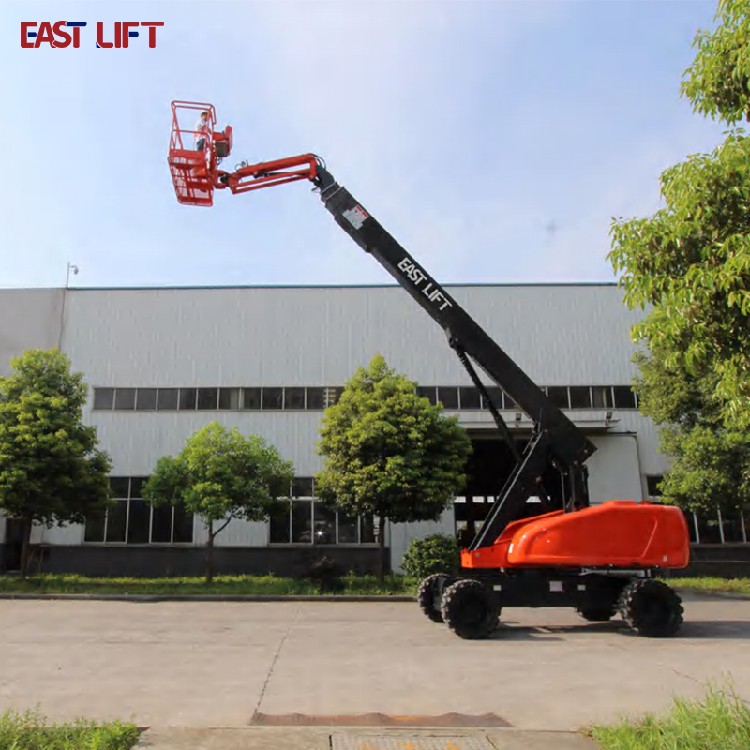
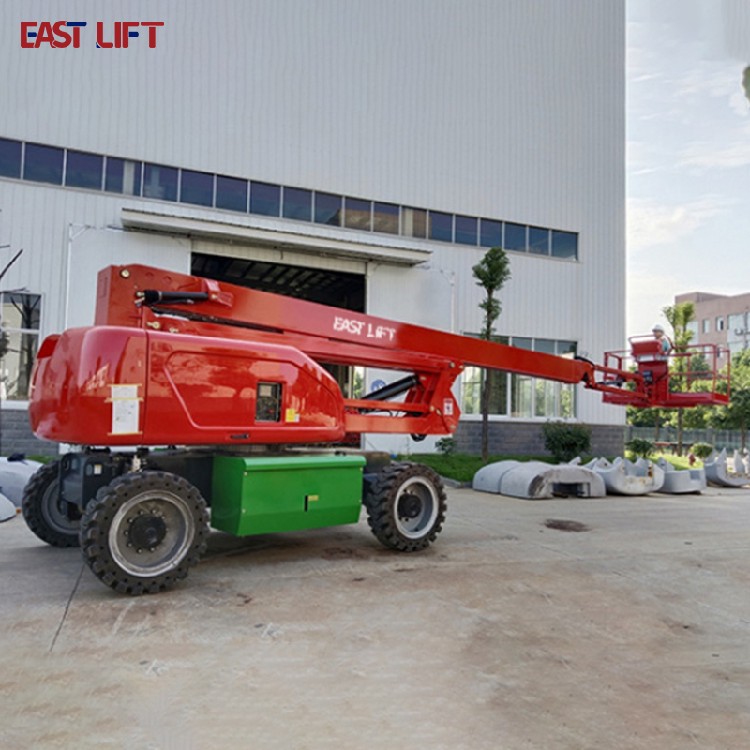
A telescopic boom lift, also known as a straight boom lift, offers dual power options: diesel or electric, depending on the needs. Its core feature is its linear telescopic boom structure, which expands the working height and radius by extending and retracting the boom sections. This design gives it a natural advantage in high-altitude, linear operations and large-scale work.
The working height of a straight boom lift typically ranges from 12 to 75 meters, with some models capable of exceeding this height. It features fast extension and retraction speeds, resulting in high operational efficiency. The platform has a strong load-bearing capacity, with most models able to carry over 450 kg, supporting multiple people working together to carry construction equipment. Equipped with multiple safety systems, including load limiting devices, its safety is paramount. However, its boom flexibility is relatively weak, making it difficult to navigate obstacles, and it is more suitable for open areas.
Applications include: installation of large LED advertising screens in city squares, construction of exterior curtain walls for high-rise buildings, and maintenance of large equipment in ports and docks.
Articulated boom lift: a powerful tool for flexible operation in complex environments
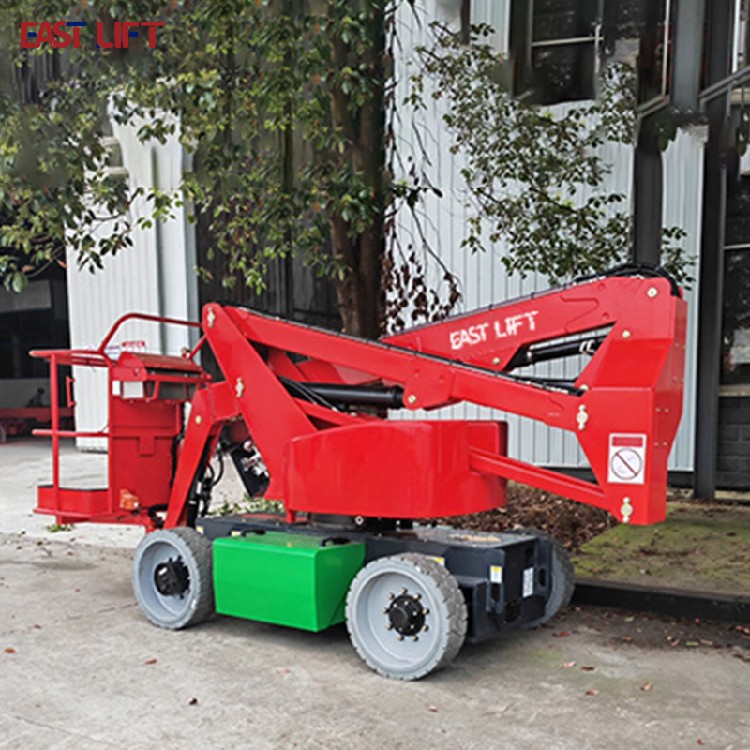
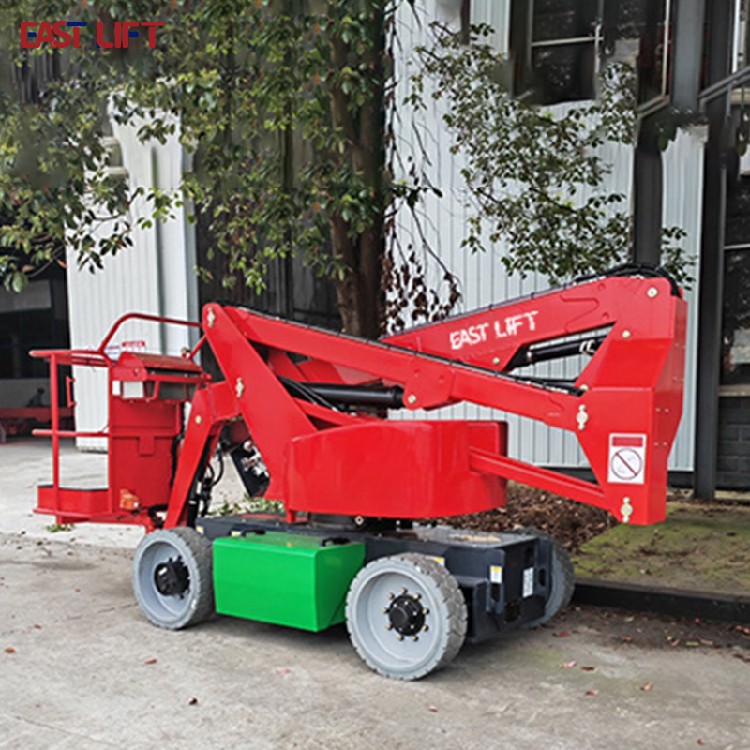
The boom lift of a boom lift is connected by multiple joints, allowing for multi-angle movements such as extension, tilting, and rotation, much like the flexible bending motion of a human arm, hence its name. This flexible and convenient towing structure makes it an excellent tool in obstacle-filled environments.
The working height of a boom lift typically ranges from 10 to 38 meters. The vehicle itself is relatively compact; it can perform suspended operations, traverse certain obstacles, and complete multiple tasks from a single lifting point. Tracked boom lifts can adapt to uneven terrain, but they also have drawbacks: a relatively small horizontal working range, slower operating speed, and a load capacity typically between 200-400 kg. Furthermore, the boom and attachments are subject to wear and tear, resulting in relatively high maintenance costs.
Applications include: street light maintenance in old urban areas, landscaping trimming in green belts, pipe installation in factory workshops, and the erection of high-altitude shots in film and television productions.
Mast-mounted boom lift: Heavy-duty lifting for special scenarios
Mast-lift boom lifts have a relatively simple structure, using an upright mast as the core support, coupled with a stabilizing system including lifting pulley blocks, winches, and guy ropes. They are mostly designed as fixed or semi-mobile. While their mobility is not as good as articulated boom lifts, their lifting capacity is significantly superior, making them a specialized boom lift type for special scenarios.
Mast-lift boom lifts have a wide lifting capacity range, capable of lifting everything from small equipment to large structures exceeding 100 kN. Assembly and disassembly are relatively convenient, with fewer restrictions on construction sites. However, they require a large number of guy ropes for stability, making movement difficult and resulting in a relatively slow working speed.
Applications: Lifting large precast components on construction sites, erecting heavy steel on bridge construction sites, loading and unloading special large equipment at ports and docks, etc. Because mast-lift boom lifts can adapt to confined spaces, they have become a core piece of equipment for lifting heavy loads.
Conclusion
In conclusion, when choosing a boom lift, you can consider the working height and load capacity requirements to determine the size of the machine; the openness of the work site or the distribution of obstacles will also help you choose the right boom lift for efficient and safe work.
Recommended Products

Contact Us
Shandong Xusheng Machinery Technology Group Co., Ltd.