Welcome!



EASTLIFT
 Share
Share


Product Description
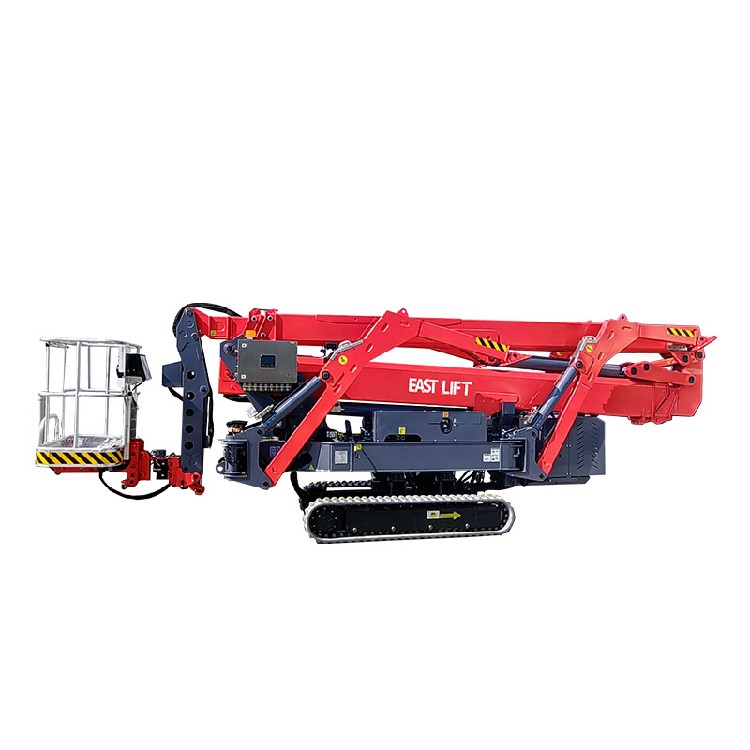
The disadvantages of spider lifts can indeed be mitigated or reduced through technological advancements, though complete elimination may be constrained by physical limitations or cost-effectiveness. Below is an analysis of how key drawbacks could evolve with technical progress, along with specific improvement directions:
I. Limitations in Working Height and Load Capacity
Current Disadvantage: 10-meter spider lifts struggle with ultra-high-altitude operations (over 10 meters) and heavy-load transportation (e.g., >230kg).
Technological Solutions:
· Advanced Materials: Carbon fiber or high-strength aluminum alloys can replace traditional steel, reducing arm frame weight by 30–50% while maintaining rigidity. This could extend working height to 15–20 meters without compromising stability.
· Hydraulic System Optimization: High-pressure hydraulic pumps and servo control valves can enhance lifting precision and load-to-weight ratio, allowing 400+ kg payloads. For example, some manufacturers now use dual-cylinder arm structures to distribute loads more evenly.
Example: The latest 16-meter spider liftsadopt carbon fiber booms, achieving a 25% increase in height without expanding the base footprint.
II. Terrain and Ground Limitations
Current Disadvantage: Struggles on extremely soft ground (e.g., swamps), steep slopes (>15°), or fragile surfaces (e.g., marble floors).
Technological Solutions:
· Adaptive Track Systems: Smart tracks with pressure sensors can adjust ground contact area in real time. For instance, inflatable rubber tracks can reduce ground pressure by 40% when navigating soft terrain.
· AI-Powered Leg Leveling: Integrated sensors and algorithms can automatically adjust each leg’s extension within 0.5° accuracy, enabling operation on 20° slopes.
· Modular Base Plates: Detachable, expandable base plates (e.g., magnetic or interlocking designs) can distribute weight over a larger area, protecting delicate floors.
Example: The Bronto Skylift Spider 140 uses gyroscopic sensors to self-level on 18° slopes, a 20% improvement over traditional models.
III. Environmental and Climatic Constraints
Current Disadvantage: Vulnerable to strong winds (>5 级), explosive environments, or corrosive conditions.
Technological Solutions:
· Electric/Pneumatic Drive Conversion: Fully electric spider lifts (e.g., the Haulotte Star 10 EVO) eliminate hydraulic oil leakage risks, making them suitable for explosive zones. Battery technology improvements (e.g., lithium-ion phosphate) now enable 8–10 hours of continuous operation.
· Weather-Resistant Design: Waterproof hydraulic seals (IP67 rating) and wind-resistant booms with aerodynamic profiles can withstand 7 级 winds (13.9 m/s), up from the current 5 级 limit.
· Anti-Corrosion Coatings: Nanocomposite coatings (e.g., zinc-aluminum alloys) can extend equipment lifespan in coastal areas from 5 to 15 years.
Example: The Skyjack SJ46 AJ electric spider lift is certified for use in Zone 2 explosive atmospheres, a first in the industry.
IV. Precision and Space Limitations
Current Disadvantage: Hydraulic systems have ±10 cm positioning errors, unsuitable for micro-manipulation or confined spaces.
Technological Solutions:
· Robotic Arm Integration: Adding 6-axis robotic arms to work baskets allows mm-level precision for tasks like semiconductor equipment installation.
· Virtual Reality (VR) Guidance: VR goggles paired with 3D site mapping enable operators to navigate complex obstacles with sub-centimeter accuracy.
· Modular Folding Structures: Telescopic booms that can fold into 1.2-meter-wide profiles fit through standard doorways, expanding indoor usability.
Example: The Hinowa Lightlift 20.10 Performance uses an electro-hydraulic hybrid system to reduce positioning error to ±5 cm.
V. Cost and Efficiency Challenges
Current Disadvantage: High rental costs (¥500–1,000/day) and low efficiency for short-term or remote tasks.
Technological Solutions:
· Modular Quick Assembly: Hydraulic quick-connect fittings and pre-assembled boom sections can cut setup time from 2 hours to 30 minutes.
· Autonomous Operation: AI-driven autonomous navigation allows the lift to move between work points without human control, reducing labor costs by 30%.
· Sharing Economy Models: IoT-connected fleetscan optimize scheduling, lowering idle costs by 50%.
Example: The Genie Z-60/34 DC articulating boom lift uses a plug-and-play design, reducing transport and setup costs by 40% compared to traditional spider lifts.
VI. Technical Limitations That May Persist
· Physical Laws: Extending height beyond 30 meters may require disproportionately large bases, conflicting with compact design.
· Extreme Environments: Subzero temperatures (-30°C+) or high-altitude hypoxia zones may still require specialized equipment .
· Niche Applications: Ultra-precise tasks (e.g., archaeological restoration) may always demand human-operated micro-tools over mechanical arms.
Recommended Products

Contact Us
Shandong East Lift Machinery Group Co., Lt d.