Welcome!


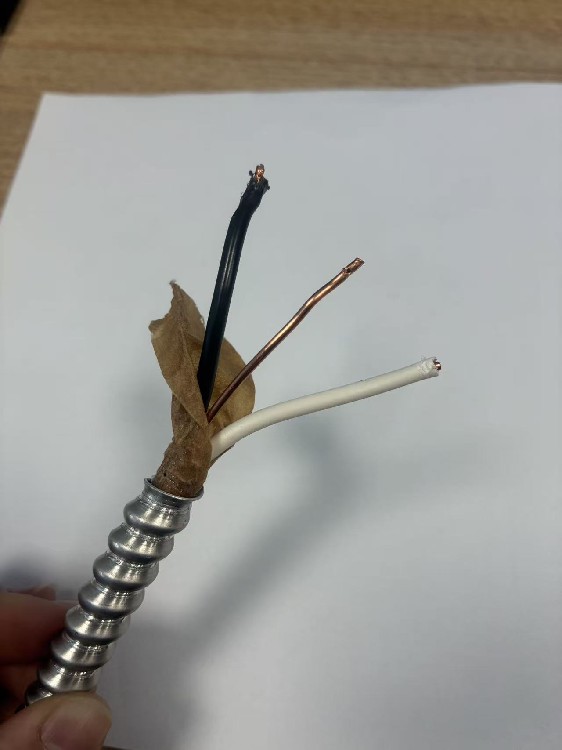
Armored Cable AC90
 Share
Share


Basic Info
| 12/3c | 14/3c | ||||
|---|---|---|---|---|---|
Product Description
How Is AC90 Armored Cable Manufactured?
AC90 armored cable is widely used in Canadian commercial and residential building wiring systems. Known for its mechanical durability and flexibility, AC90 features an interlocked aluminum armor that provides reliable protection without the need for conduit.
But how exactly is the armor produced?
In this article, we break down the manufacturing process of AC90 armored cable—focusing especially on how its aluminum armor is formed.
1. What Type of Armor Does AC90 Use?
AC90 cable uses:
Interlocked Aluminum Armor
This is not corrugated steel tape, and not foil shielding.
Instead, it is a continuous aluminum strip mechanically formed and interlocked around the cable core.
The result is a flexible, mechanically strong metal sheath that protects conductors from impact and compression.
2. Raw Materials for the Armor
The armor begins as:
• Aluminum strip (typically 3000 or 5000 series alloy)
• Thickness usually ranges from 0.2 mm to 0.5 mm (depending on cable size)
The aluminum must offer:
• Good elongation
• Crack resistance
• Smooth surface finish
• Consistent thickness
3. Step-by-Step Armor Manufacturing Process
Step 1: Cable Core Preparation
Before armoring, the cable core is completed:
• Copper conductors
• XLPE (RW90) insulation
• Binder tape or fillers
The finished core is fed into the armoring machine.
Step 2: Aluminum Strip Forming
The aluminum strip enters the armoring line and passes through forming rollers.
These rollers:
• Shape the strip into a corrugated (wave-like) profile
• Increase flexibility
• Improve crush resistance
Step 3: Helical Wrapping
The formed aluminum strip is helically wrapped around the cable core at a controlled angle.
This creates a spiral metallic sheath.
Step 4: Interlocking Mechanism
This is the key feature of AC90 armor.
One edge of the aluminum strip is shaped as a “hook” and the other as a “groove”.
During wrapping:
• The hook edge locks into the groove edge
• The strip mechanically interlocks
• No welding
• No adhesives
• No soldering
This produces a continuous, flexible, self-locking armor structure.
Step 5: Diameter Calibration
After interlocking:
• The armored cable passes through calibration rollers
• Outer diameter is controlled
• Roundness is maintained
• Armor tightness is verified
Step 6: Final Testing
Finished AC90 cable undergoes:
• Armor integrity testing
• Mechanical compression testing
• Cold bend testing
• Continuity testing (for bonding)
• CSA compliance inspection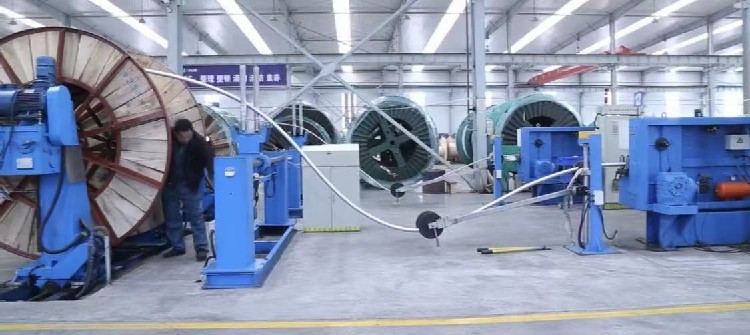
Recommended Products




Recently Viewed
Contact Us
Qingdao Cable Co., Ltd.